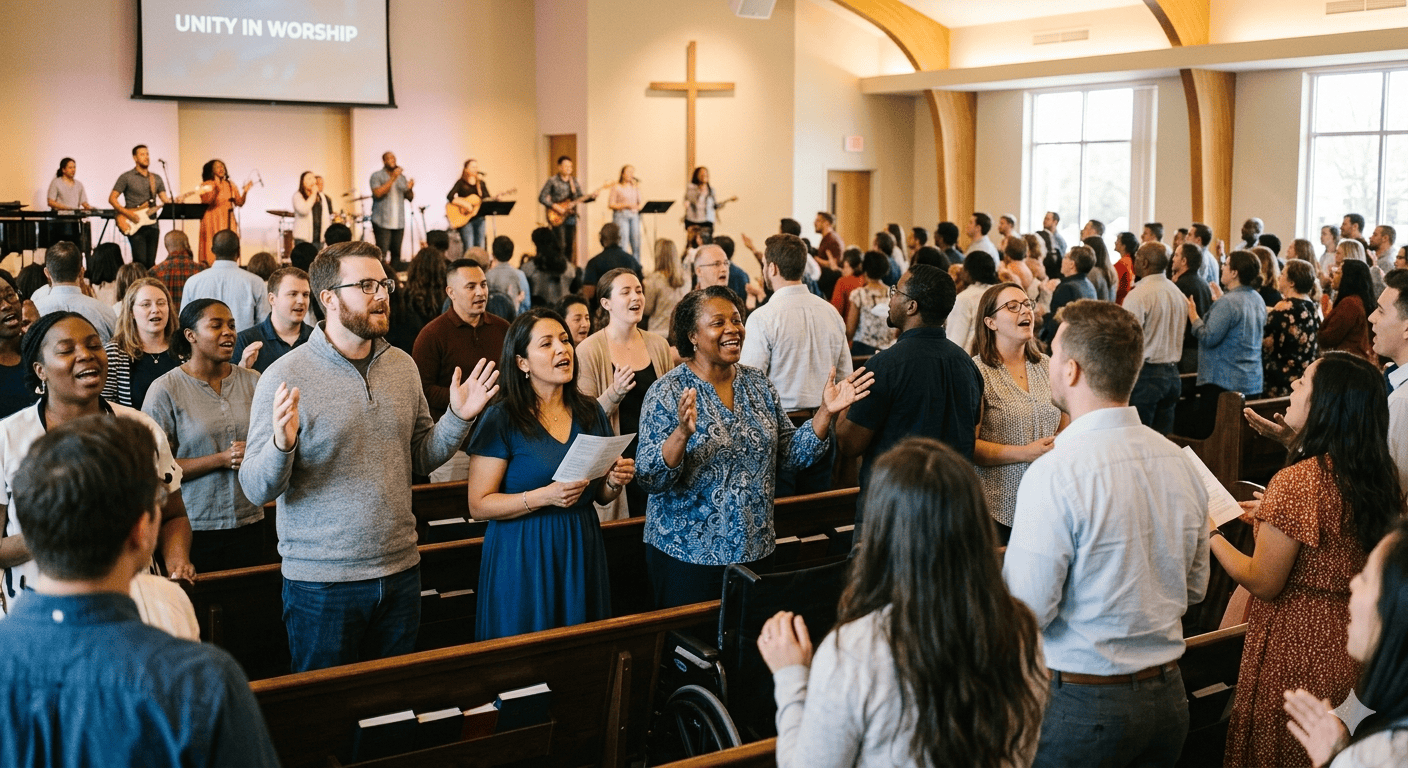
I remember visiting a church where an usher handed me a tri-fold bulletin printed on both sides in what looked like seven-point type. They had tried to fit the entire service onto one sheet.
I took it and tried to follow along. I wanted to know the order of worship, which hymns we would sing, and what was coming next.
But I could not read it.
I could not see a hymn board either, if there was one. So I sat through the service without knowing where we were in the liturgy or what I was being invited to do.
I do not think the person handing me the bulletin made any assumption about me. That was simply the normal bulletin for that congregation.
And that is part of the problem.
Inaccessibility is often not the result of cruelty. It is the result of designing worship around an imagined “normal” person and never noticing who gets left out.
Disability-inclusive worship begins when a church imagines people with disabilities as part of the congregation from the beginning—not as visitors who may arrive later and require special arrangements.
This is not only a checklist of technical fixes.
It is part of what it means to tell the truth about the body of Christ.
Disability-Inclusive Worship Is Theological
Churches often speak about accessibility as if it were an optional addition to the “real” work of ministry.
A ramp gets discussed after the budget is finished. Large-print materials are created only after someone asks. Captions are considered once an online participant says they cannot follow the service.
Those responses may be sincere, but they reveal something important: the person who needed access was not expected when the worship was planned.
Disability-inclusive worship asks a different question:
What would this service look like if people with disabilities were already part of the planning, leadership, and life of the congregation?
That question changes more than a few practical details.
It changes who we imagine when we say “the congregation.”
It changes what we mean by participation.
It changes who gets to lead.
It changes whether access is understood as charity or as part of belonging.
For the theological foundation behind this approach, begin with Disability Theology 101: Why Your Church Needs This Conversation.
From Accommodation to Belonging
Accommodation asks:
What can we change now that someone has arrived?
Belonging asks:
What would we have built if we expected this person to be here from the beginning?
Accommodation may mean moving a chair when someone who uses a wheelchair arrives.
Belonging means designing flexible seating throughout the worship space so no one is isolated at the back or edge of the room.
Accommodation may mean printing one large-print bulletin after someone requests it.
Belonging means making large-print and digital materials part of the normal worship preparation.
Accommodation may mean bringing communion to someone only after they explain that they cannot approach the altar.
Belonging means offering multiple ways to receive communion and clearly explaining those choices to everyone.
Accommodations matter. They are often necessary and good.
But they should lead us toward something deeper: a congregation in which people with disabilities do not have to keep announcing that they exist.
Begin by Listening
The most important tool for disability-inclusive worship is not something a church can purchase.
It is a willingness to listen.
Ask people with disabilities about their actual experience of worship.
You might ask:
- Where do you feel fully included?
- Where does worship become tiring, confusing, painful, or inaccessible?
- Are there moments when you have to ask publicly for help?
- What would make participation easier or more meaningful?
- What do church leaders assume about your needs that may not be accurate?
- What gifts or leadership would you like to offer?
Do not ask only when a problem has already occurred.
Invite people with disabilities into ongoing worship planning, accessibility conversations, building decisions, and leadership.
Then believe what they tell you.
Lived experience should not be treated as a suggestion that leaders politely receive and quietly set aside. It should have real authority in the life of the congregation.
Physical and Mobility Access
Physical access includes far more than whether the building has a ramp.
Pay attention to:
- entrances and doorways
- accessible restrooms
- aisles and turning space
- seating arrangements
- sightlines
- communion practices
- access to the chancel or lectern
- parking and transportation
- how easily people can move without asking for assistance
People who use wheelchairs, walkers, canes, or other mobility devices should be able to sit with family and friends rather than being confined to one designated area.
At least one route to the front should be accessible—not only so someone can receive communion, but so people with disabilities can serve as readers, musicians, communion assistants, presiders, and leaders.
Communion should not assume that everyone can walk, stand in a line, hold a small cup, or navigate steps.
Offer choices such as:
- receiving communion at one’s seat
- a seated station
- an accessible route to the table
- assistance carrying elements when requested
- clear verbal explanation of the options
The goal is not to single anyone out.
It is to make multiple forms of participation normal.
Visual and Print Access
Small print, poor contrast, crowded slides, and visually complicated layouts can turn worship into guesswork.
For printed materials, consider:
- large-print options
- a clean, readable typeface
- generous spacing
- strong contrast
- uncluttered page layouts
- avoiding glossy paper when glare may be a barrier
- digital copies that can be enlarged or used with assistive technology
There is no single font size that works for every person with a visual disability. Ask the people who will use the materials what helps them.
Projected slides should include:
- fewer words per slide
- large text
- strong contrast
- no essential text placed over busy images
- consistent placement and formatting
- spoken descriptions of essential visual information
Do not assume that a screen is automatically more accessible than a bulletin.
For some people, it is helpful. For others, it is unusable.
Offer more than one way to follow worship.
For practical guidance about interacting respectfully with someone who is blind or has low vision, see How to Offer Help to Someone Who Is Blind or Has Low Vision once that article is ready.
Hearing and Communication Access
Good hearing access begins with consistent microphone use.
Every person who speaks should use a microphone, including:
- worship leaders
- readers
- musicians when speaking
- people offering announcements
- participants asking questions
- anyone sharing during a discussion
A microphone is not only for people who are “soft-spoken.” It is an accessibility tool.
Other practices may include:
- assistive listening systems
- receivers that work with headphones or hearing aids
- captions for livestreamed and recorded worship
- printed or digital copies of spoken material
- clear signage explaining where listening devices are available
- ushers who know how the equipment works
- regular charging, testing, and maintenance
Room acoustics also matter.
A louder sound system does not necessarily make speech clearer. Echo, background noise, and uneven sound can make listening exhausting.
Before purchasing equipment, talk with people who are Deaf or hard of hearing, consult a qualified audio professional, and consider which system fits the building and congregation.
Do not assume that one device will meet every need.
Sensory and Cognitive Access
Worship can be overwhelming for people with a wide range of sensory or cognitive access needs.
This may include people who are autistic, have ADHD, live with brain injuries or dementia, experience trauma responses, or process sound, light, language, and movement differently.
Their needs are not interchangeable.
No single “sensory-friendly” service will work for everyone.
A better starting point is to offer predictability, choice, and clear communication.
Consider:
- publishing the order of worship in advance
- explaining what participants can expect
- clearly naming transitions
- warning people before sudden loud sounds, flashing lights, or dramatic changes
- offering seating near an exit without isolating anyone
- allowing people to move, use headphones, hold sensory tools, or leave and return without shame
- reducing strong scents
- providing a quieter space where worship can still be heard or viewed
- avoiding public assumptions about why someone participates differently
A worship roadmap can be especially helpful. It might explain the service in plain language:
We will begin with music.
There will be a spoken prayer.
The congregation will be invited to sing.
There will be a period of silence lasting about one minute.
Communion will be offered at the front and at people’s seats.
Clear communication lowers uncertainty without requiring anyone to disclose a diagnosis or explain an access need.
Quiet sensory tools may also be useful for some people. Offer a small range without presenting them only as children’s items or making people request them publicly.
Language and Posture
Words reveal who a congregation expects to be present.
Phrases such as “Please stand,” “We can all see,” or “Everyone is able to…” may unintentionally treat one kind of body or sensory experience as universal.
A phrase like “Please stand as you are able” is better than an unqualified command, but standing can still remain the expected or spiritually preferred posture.
At Peace, we often use:
Either in body or spirit, please rise.
Other moments may not need a posture instruction at all:
Let us pray.
Let us hear the Gospel.
Let us prepare to worship together.
The goal is not to remove embodied worship.
Posture can carry deep meaning.
The goal is to stop presenting one posture as the measure of reverence, participation, or faithfulness.
Pay attention to disability-based metaphors as well.
Phrases such as “blind to the truth,” “falling on deaf ears,” “lame excuse,” or “crippled by fear” use disability as shorthand for ignorance, failure, or spiritual deficiency.
Choose language that names what you actually mean:
- overlooked
- ignored
- unwilling to listen
- afraid
- restricted
- prevented
- excluded
For a fuller reflection on posture and worship language, see Why “Please Stand” Is a Theology Problem once that piece has been updated.
Communion, Sacraments, and Participation
Sacraments are often described as signs of grace, but the way they are offered can still create barriers.
Ask:
- Can people receive communion without navigating stairs?
- Can someone receive at their seat without becoming a spectacle?
- Are gluten-free elements offered safely and clearly?
- Can someone who cannot hold a cup receive in another way?
- Are instructions spoken and printed?
- Are people pressured to move quickly?
- Can people with communication disabilities participate without being rushed?
- Can people with disabilities serve at the table and not only receive from it?
The same questions apply to baptism, confirmation, anointing, laying on of hands, and other embodied practices.
Do not assume that physical touch is always welcome.
Explain what will happen. Ask consent. Offer alternatives.
Access should shape leadership as well as reception.
People with disabilities should be invited to preach, read, preside, sing, teach, assist, and serve in visible roles.
A congregation has not fully embraced disability inclusion if people with disabilities are welcomed into the pews but never expected in the pulpit, choir, council, or at the table.
Digital and Hybrid Participation
Online worship is real worship participation for many people.
It is not always a temporary substitute for attending in person.
People may participate online because of disability, illness, fatigue, transportation barriers, caregiving responsibilities, weather, anxiety, or many other circumstances.
Digital access may include:
- accurate captions
- clear audio
- readable slides
- verbal descriptions of visual actions
- links to worship materials in advance
- accessible online forms
- keyboard-friendly navigation
- meaningful alt text for images
- transcripts for recorded content
- an online host who acknowledges and supports remote participants
Do not speak about online participants as though they are absent.
Welcome them. Include them in prayer. Explain how they can participate in communion, conversation, giving, or follow-up.
An inaccessible website or livestream can quietly turn people away before they ever experience the congregation’s welcome.
For more on digital access, see Digital Hospitality: Is Your Church Website a Virtual “No Entry” Sign? once that article has been reviewed.
A 90-Day Starting Plan
Accessibility can feel overwhelming when a congregation sees everything that could change.
You do not have to fix everything at once.
You do need to begin.
During the First 30 Days
Choose a few immediate changes:
- review standing language and disability-based metaphors
- make large-print materials consistently available
- require every speaker to use a microphone
- clearly explain communion options
- ask people with disabilities about their worship experience
- check whether online worship has usable captions
These changes may cost little or nothing.
They communicate that the congregation is paying attention.
During Days 31–60
Take a deeper look at systems:
- conduct an accessibility walk-through
- test assistive listening equipment
- review entrances, restrooms, signage, and seating
- publish worship materials in advance
- identify sensory barriers
- train ushers and worship leaders
- invite people with disabilities into decision-making
Do not form an accessibility team made up entirely of people without disabilities.
During Days 61–90
Begin longer-term planning:
- establish a budget for access improvements
- create a process for reporting barriers
- include accessibility in worship and event planning
- review leadership opportunities
- plan education on disability theology
- set realistic goals with dates and responsibility assigned
- communicate openly about what has changed and what remains unfinished
Keep asking:
Who is still being left out?
And then ask:
Who needs to be in the room before we decide what to do next?
Compliance, Accessibility, Hospitality, and Belonging
These words are related, but they are not interchangeable.
Compliance asks whether minimum legal standards have been met.
Accessibility asks whether people can enter, understand, participate, and use what the church offers.
Hospitality asks whether people are received with care and respect.
Belonging asks whether people are expected, valued, able to lead, and recognized as essential to the community.
A church can technically comply with a standard and still make participation exhausting or humiliating.
It can offer warm hospitality while expecting people to repeatedly ask for basic access.
Belonging is the deeper goal.
A Hopeful Invitation for Church Leaders
If you are reading this as a pastor, worship leader, musician, council member, or volunteer, you do not have to know everything before you begin.
You do not have to install every ramp, purchase every device, or rewrite every practice by next Sunday.
But you can take one faithful step.
You can listen.
You can notice.
You can change the language.
You can make participation easier without requiring people to ask.
You can invite people with disabilities to shape the life of the congregation.
You can stop treating access as an interruption to ministry and begin recognizing it as part of ministry itself.
The goal is not a perfect service.
The goal is a worshiping community where people with disabilities are expected, valued, able to participate, and invited to lead.
That is not an extra program.
It is part of what the church is called to become.
For more theological reflection and practical resources, explore Accessibility and Belonging.
Faith, Upgraded is where I share more honest, hope-centered reflections on disability, faith, church, and the work of creating communities where people are not merely welcomed, but expected.