
What if the most important theological voices in your congregation are the ones you have been trained not to notice?
Most churches think about disability, if they think about it at all, as a logistics question.
Where do we put the ramp?
Who handles the sign language interpreter budget?
What happens if someone who uses a wheelchair needs to get to the front for communion?
These are real questions, and they matter. But they are not the first questions.
When disability is treated primarily as a facilities issue, theology gets flattened into a checklist. Disability theology begins somewhere deeper. It asks what it means to be made in the image of God, and it refuses to answer that question without disabled people in the room.
I noticed this long before I had language for it.
When I was growing up, my home church’s contemporary service began moving more of worship onto screens. We still had printed bulletins then, so I could follow along, but I watched slides fill with more and more text—designed, like most things, for people who could read them easily from across the room.
I also remember hearing, “Please stand as you are able,” and doing the quiet math that phrase still required. Standing remained the expected posture. Not standing was the exception that needed explaining, even if only to myself.
What if I am not able?
Does that make me less fully part of what is happening here?
Those questions are exactly where disability theology begins.
What Disability Theology Actually Is
Disability theology is sustained, serious theological reflection that takes disability not as a problem to be solved, but as a genuine site of divine encounter, human meaning, and theological insight.
It asks familiar questions with new attention:
- What does it mean to bear God’s image?
- What does a whole body look like?
- What assumptions do Christians make about suffering, healing, and faith?
- What did Jesus’ resurrected body carry forward from the cross?
- Who gets treated as a theologian, and who is treated only as a recipient of care?
The field has been shaped for decades by theologians who themselves live with disabilities.
Nancy Eiesland’s work on the “disabled God,” for instance, drew attention to the risen Christ still bearing the wounds of crucifixion. That matters enormously for how Christians think about bodies the world calls broken.
Disability theology is not a small subfield added onto pastoral care.
It is a lens that changes how the whole of theology gets read.
It is also not the same thing as accessibility ministry, though the two should remain in close conversation.
Accessibility ministry asks how to remove barriers.
Disability theology asks an earlier question:
What have we assumed about God, the body, and human worth that allowed those barriers to be built in the first place?
Why Access Is a Theological Question
It is tempting to treat accessibility as a budget line—something added after the “real” ministry priorities have been funded.
Disability theology says that gets the order backward.
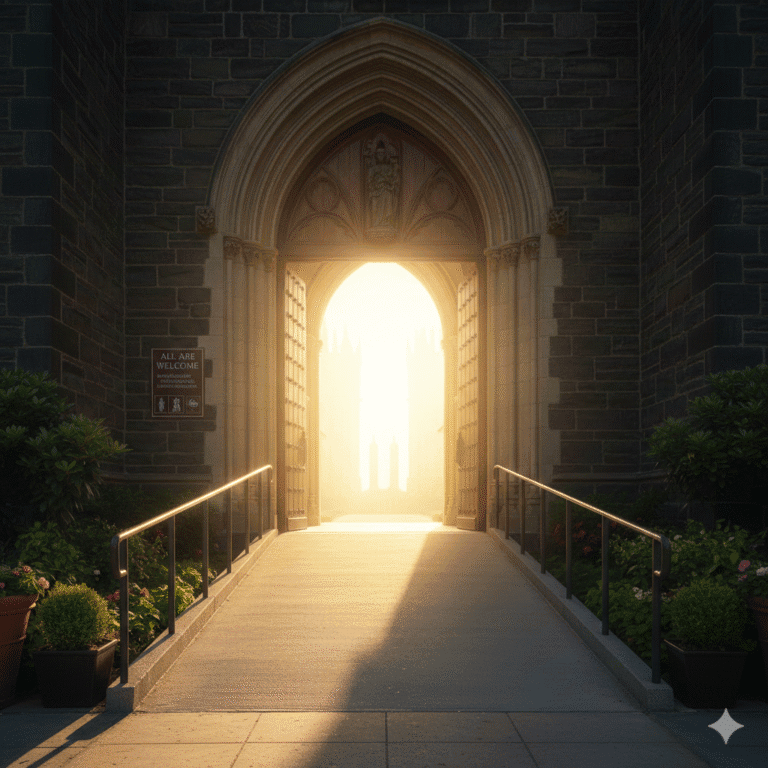
A building without a ramp is not only inconvenient. It communicates something, whether anyone intended it or not: some bodies were expected here, and others were not.
A worship service without large-print materials, captions, interpretation, or meaningful ways for Deaf and hard-of-hearing people to participate teaches a similar lesson.
Access is never only about entry.
It is about who a community, at the level of its architecture, worship, habits, and leadership, actually expected to belong.
That is why accessibility belongs in theological conversations, not only building-committee meetings.
Cure, Healing, and Wholeness
Few conversations trip up well-meaning churches faster than healing.
It helps to name three ideas that are often collapsed into one.
Cure
Cure is the elimination or significant reduction of a condition.
It is a medical outcome. For some people, in some circumstances, it is genuinely desired and celebrated.
Healing
Healing can be larger than cure.
In biblical and pastoral contexts, healing may include restored relationship, renewed dignity, freedom from shame, reconciliation with oneself, or a return to community.
None of those require a disability to disappear.
Wholeness
Wholeness is not the absence of disability.
Wholeness is the fullness of a person as they actually are, in relationship with God and community, without a precondition attached.
When a church quietly teaches that faithful healing requires cure, it tells every disabled person in the room that their body remains a problem waiting to be solved.
That is not a minor theological mistake.
For many people, it is the very message that made church unsafe.
Reading Scripture Without Reducing People to Symbols
Disability theology can help Christians notice bodies and experiences in Scripture that have often been ignored.
But it also requires interpretive humility.
Ambiguous biblical figures should not be turned into convenient disability examples simply because they support a point we already want to make.
A few examples show why caution matters.
Moses
In Exodus 4:10, Moses describes himself as “slow of speech and slow of tongue.”
Some readers hear a speech impairment. Others understand Moses to be questioning his rhetorical ability rather than naming a physical condition.
The text leaves room for more than one interpretation.
Jacob
After wrestling at the Jabbok in Genesis 32, Jacob walks away with a lasting limp.
This is one of the clearer examples of a body permanently marked by divine encounter. Even here, applying a modern category such as disability to an ancient text is an interpretive decision worth naming.
Paul
Paul’s “thorn in the flesh” in 2 Corinthians 12 has been interpreted in many ways: chronic illness, impaired vision, epilepsy, depression, spiritual opposition, and persecution, among others.
Paul never identifies it.
Any confident claim about what it “really” was goes beyond what the text supports.
None of this means these passages have nothing to offer disability theology.
It means we should hold them with open hands—naming what the text can support, acknowledging what it cannot, and refusing to reduce whole people to illustrations.
For a more sustained reading of one biblical story, see What John 9 Really Says About Disability, Grace, and Belonging.
Disabled People as Theologians, Leaders, and Full Members of the Body
The disability rights movement has a phrase that belongs in every church leadership meeting:
Nothing about us without us.
It names a simple and persistent pattern: decisions about disabled people are often made in rooms where no disabled person is present or consulted.
Churches do this constantly, usually without noticing.
An accessibility committee forms with no disabled members.
A sermon series on suffering is written without speaking to someone who actually lives with the experience being described.
A building renovation is approved before anyone who uses a mobility device, has low vision, or navigates sensory barriers is invited to review the plans.
Disabled people are not only recipients of the church’s ministry.
They are, and have always been, theologians, preachers, musicians, teachers, elders, deacons, leaders, and some of the church’s most attentive readers of Scripture.
A congregation that positions disabled people only as the objects of compassion has quietly decided who gets to lead and who only gets to be helped.
That is not hospitality.
It is hierarchy wearing hospitality’s clothes.
Accommodation Is Not the Same as Belonging
Accommodation asks:
How do we make room for someone who has already arrived?
Belonging asks an earlier and more demanding question:
What would we build if we expected this person to be here from the beginning?
The difference appears in small things.
A ramp installed at a separate side entrance accommodates.
A building designed with one dignified entrance for everyone reflects belonging.
One interpreted service each month accommodates.
Interpretation built into the regular rhythm of worship reflects belonging.
A space at the back of the sanctuary for a wheelchair user accommodates.
Flexible seating throughout the worship space reflects belonging.
Accommodation says, “You may come in.”
Belonging says, “We built this with you in mind.”
Most churches are capable of accommodation.
Belonging asks more of a community’s imagination—and it is the harder, truer goal.
Why Lived Experience Matters
Theology done without disabled people in the room is not neutral theology.
It is theology written from one particular vantage point that has forgotten it has a vantage point at all.
This is what “nothing about us without us” protects.
Not politeness.
Accuracy.
A church that writes its accessibility policy, plans its worship, preaches about suffering, or redesigns its building without disabled people present will make mistakes it may not even recognize.
The questions that could have exposed the problem were never asked.
Here is what I know now that no seminary class taught me:
Not being cured does not mean you did something wrong.
It does not make you less faithful.
It does not make you less whole.
Scripture’s healing stories can create their own kind of ache for those of us still living with what was not taken away.
But God calling us good was never a consolation prize for those whose disabilities remain.
It is the starting point of Christian anthropology, not a lesser blessing offered when cure does not come.
What Disability Theology Looks Like in Practice
Theology that never reaches the building, the bulletin, the website, the budget, and the leadership table is not finished yet.
Here are a few places to begin.
Worship
Look at worship with fresh attention.
Notice:
- standing cues that treat one posture as normative
- liturgy that can only be followed by hearing or sight
- rooms darkened without warning
- communion practices that assume full mobility
- music or spoken responses without captions or printed alternatives
- moments when participation depends on moving, speaking, singing, or processing quickly
Small language shifts can matter.
Instead of “Please stand,” consider language such as:
Either in body or spirit, please rise.
Or simply:
Let us prepare to worship together.
The goal is not to eliminate embodied participation.
It is to stop presenting one body, one posture, or one way of participating as the measure of faithfulness.
Leadership
Who is actually in the room when your church makes decisions about accessibility, worship, preaching, building use, technology, or communication?
If the honest answer is “no disabled people,” that is the first thing to change.
Do that before writing another policy.
Buildings
Access includes ramps, restrooms, and seating, but it does not end there.
Consider:
- entrances
- clear and readable signage
- lighting
- acoustics
- sightlines
- scent
- transportation
- navigation
- seating that does not isolate wheelchair users
- whether people must publicly request “special help” to participate
Walk through the building with people who use mobility devices, have low vision, are Deaf or hard of hearing, or have sensory access needs.
Ask what you are not seeing.
Communication
Accessible communication may include:
- large print
- audio versions
- captions
- ASL interpretation
- plain-language explanations
- clear verbal descriptions
- readable slides
- consistent formatting
- advance access to materials
And one of the most important practices is simple:
Ask rather than assume.
Digital Ministry
An inaccessible website can quietly turn away the same people a physical ramp is meant to welcome.
Poor contrast, missing alt text, inaccessible forms, no keyboard navigation, and videos without captions all communicate who was imagined as the intended user.
Digital accessibility is not separate from ministry.
It is ministry.
Where to Go From Here
If disability theology is new to you, welcome.
This is a good place to begin, and it is meant to be walked through slowly, not mastered in one sitting.
If you are disabled and tired of fighting for basic inclusion in faith communities, I see you.
This conversation exists because your presence and perspective were never a burden.
If you are a church leader wondering where to start, begin by listening.
Then notice who is not in the room when decisions are being made.
The rest follows from there.
What if the fullest picture of God’s image does not merely include disabled people, but requires their presence, wisdom, leadership, and witness?
That is not a radical claim.
It is simply faithful theology.
This article anchors the Accessibility and Belonging hub. From here, the practical guides go deeper into worship, leadership, communication, digital access, and everyday belonging.
Faith, Upgraded is where I share more honest, hope-centered reflections on disability, church, faith, and the work of creating communities where people are not merely welcomed, but expected.